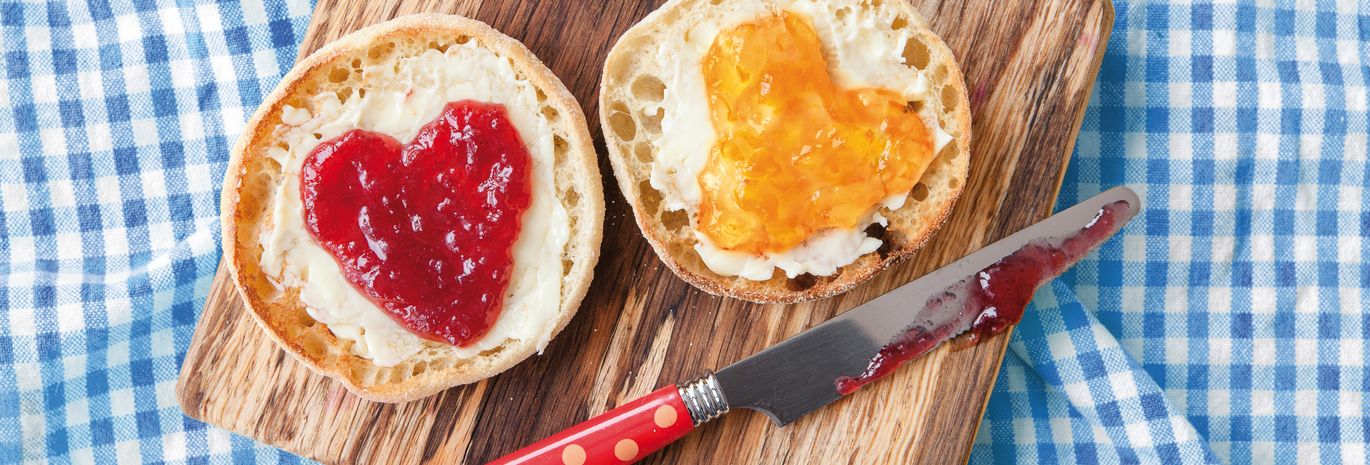
Biting into a delicious jam roll in the morning, dipping a croissant into a tasty fruit spread or simply stirring a spoonful of preserve into your muesli: there are many different names for sweet fruit spreads, including jam, extra jam, jelly, extra jelly, fruit spread and marmalade. In everyday language, these terms are often used interchangeably. But why are there so many different names? And what exactly are the differences? You can find the answers, along with other useful information, in our product guide.
The terminology is precisely regulated by the EU. The requirements of the EU Jam Directive must be implemented through national legislation in each individual country. The German Jam Ordinance defines what the various product categories may or may not contain and how the natural ingredients must be processed.
Whether it is jam, jelly, marmalade or another fruit product, they are generally made from the same basic ingredients: fruit, sugar and/or other types of sugar, food acid such as citric acid, and pectin, a natural gelling agent. Only vanilla, spirits, herbs and spices may be used for flavouring. However, the products differ both in how they are made and in how they are defined by law. The revised 2026 EU Jam Directive modernised a number of provisions and adapted them to current consumer preferences. Below, we explain the most important differences in a clear and straightforward way.
Jam is a spreadable preserve made from one or more types of fruit, sugar and, where applicable, water. Depending on the fruit used, lemon juice, pectin or other permitted ingredients may also be added.
Whether the label says “jam” or “extra jam” is regulated by law. The main difference is the fruit content. There are also stricter requirements governing how the fruit may be processed.
Both products must have a legally regulated total sugar content of more than 55 g per 100 g. The total sugar content comprises the added sweetening ingredients, such as sugar and glucose, as well as the naturally occurring fruit sugar.
In brief, jam:
• is made from fruit pulp, fruit purée or a mixture of the two
• must contain a legally prescribed minimum fruit content of 45% for many types of fruit
• uses sugar to provide sweetness, consistency and shelf life
• may only be described as jam if it meets the relevant legal requirements
Typical characteristics of extra jam:
• For many types of fruit, the legally required fruit content is higher than for standard jam and must be at least 50%.
• Exceptions apply to fruits such as rosehips, red and blackcurrants, sea buckthorn and quinces. Due to their intense flavour, a fruit content of 45% is sufficient for extra jam.
• It is generally made from fruit pulp, meaning whole, chopped or crushed fruit.
• It may contain fruit purée only in legally defined exceptional cases, for example in rosehip extra jam or seedless extra jams made from certain berries.
Consumers looking for a particularly fruity flavour often choose extra jam, as it generally contains more fruit.
Unlike jam, jelly does not contain pieces of fruit or fruit purée.
Jelly is made exclusively from fruit juice or aqueous fruit extracts. This produces a clear, uniform spread with a fine, gel-like consistency.
As a general rule, both jelly and extra jelly must also have a legally regulated total sugar content of more than 55%.
Typical characteristics of jelly:
• made from fruit juice or fruit juice concentrate
• contains no pieces of fruit
• has a clear appearance
• has a smooth, spreadable consistency
• the quantity of juice or aqueous fruit extract must be at least equivalent to the quantity prescribed for jam
• for many fruits, this corresponds to 45%
What does extra jelly mean?
• Extra jelly generally contains a higher proportion of fruit-based ingredients than standard jelly.
• For many fruits, this corresponds to a fruit content of 50%.
• Lower minimum quantities apply to certain fruits, including currants, rosehips, quinces, ginger and passion fruit.
In everyday language, almost any sweet fruit spread may be referred to as marmalade.
However, until June 2026, the legal position in Germany was different. Previously, the term “marmalade” could generally only be used commercially for products made from citrus fruits, such as oranges, lemons, limes, grapefruits or mandarins.
Products that meet the requirements for jam or extra jam may now also be described as marmalade or extra marmalade.
Products made from citrus fruits will in future be called citrus marmalade.
Fruit spread is a broader term for sweet, spreadable fruit preparations. It is often used when a product does not fall within one of the legally defined categories such as jam, extra jam or jelly.
There can be various reasons for this:
• a lower sugar content
• alternative sweeteners
• a particularly high fruit content
• unusual ingredients
• modern or creative recipes
Fruit butter is a thick, spreadable fruit preparation. It is made from fruit that has been chopped, puréed, sieved or processed into a soft mixture and then cooked down.
Typical characteristics:
• made from fruit that has been processed into a thick, spreadable mixture
• cooked for longer than many other fruit spreads
• usually darker, denser and less gelled than jam or jelly
• contains a particularly high proportion of fruit in accordance with the German Guidelines for Fruit Products: for example, at least 140 g of plum pulp or plum purée is used to produce 100 g of plum butter
• is not subject to the same requirements as jam or jelly, but is treated as a separate product category
In brief, plum butter is neither jelly nor jam. It is a particularly thick, cooked-down fruit preparation with its own distinctive character.


 Info
Info 
Company address: Industriestr. 11, 97437 Hassfurt
Tel.: +49 (0)9521 9495-0
Fax: +49 (0)9521 9495-960
E-Mail: export@maintal-konfitueren.de
Martina Dütsch-Cerbone
Tel.: +49 (0)9521 9495-311
Fax: +49 (0)9521 9495-960
E-Mail: duetsch-cerbone@maintal-konfitueren.de
Sonja Käb
Tel.: +49 (0)9521 9495-312
Fax: +49 (0)9521 9495-960
E-Mail: kaeb@maintal-konfitueren.de